
Does Size Really Matter?
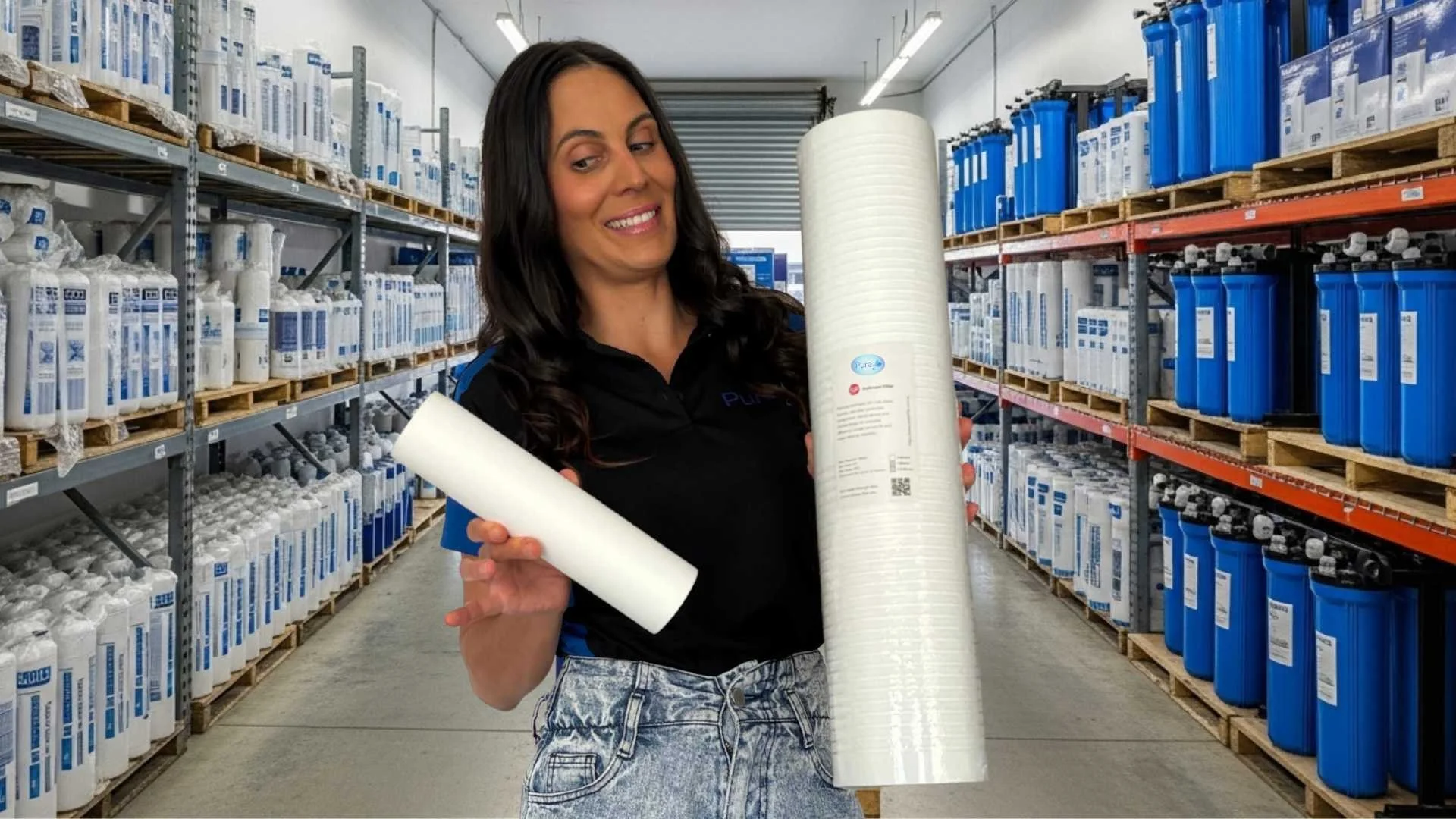
Small vs large whole-house water filters — same job, very different results.
Small vs Large Water Filters
Does Size Really Matter?
Let’s get this out of the way early.
It’s a question humanity has been nervously sidestepping for generations. In most conversations, the answer is diplomatic, nuanced, and carefully phrased to protect feelings.
In water filtration?
It’s refreshingly simple.
Yes.
Size matters.
A lot.
And unlike most situations where this question comes up, we can prove it with physics, chemistry, and a little bit of real-world experience—especially here in Perth, where water quality, pressure, and demand make size impossible to ignore.
So let’s talk openly. Calmly. Maturely. About filters.
Perth Water Isn’t Gentle (and It Never Has Been)
Perth’s water supply is a unique blend of groundwater, desalinated seawater, and surface sources. That combination brings with it:
higher mineral content
disinfectants like chlorine and chloramine
emerging contaminants such as PFAS
fluctuating pressure depending on suburb and time of day
From coastal areas like Alkimos, Yanchep, and Mindarie, to inland suburbs such as Joondalup, Baldivis, Ellenbrook, and Canning Vale, water quality may vary—but household demand doesn’t. Perth is notorious for its hard water.
Perth homes don’t sip water politely. They use it properly. Multiple showers. Appliances running. Irrigation kicking in. And when demand rises, filtration systems get exposed for what they really are.
The Temptation of Small
Smaller filters are… attractive.
They’re compact.
They’re discreet.
They promise a lot without taking up much space.
On paper, they look like a tidy solution. Easy to install. Easy to live with. No drama.
And at first? They perform… fine.
You’re not exactly telling your mates about it, but when you’ve had no filtration at all, something feels better than nothing. Early performance can be convincing.
But first impressions and long-term capability are very different things.
Small filters work hard early, then fade quietly. Flow drops. Performance declines. Replacement intervals shrink. It’s not poor engineering—it’s basic capacity limits.
There’s only so much work a small system can do before it starts struggling.
Surface Area: Where the Real Work Happens
Filtration isn’t magic. It’s contact.
Water needs time and surface area to interact with filtration media. This is especially true for stubborn contaminants like chlorine, chloramine, and PFAS—chemicals that don’t politely disappear on first contact. How PFAS is removed from drinking water.
Smaller filters simply don’t offer much room to work with.
Less surface area means:
shorter contact time
reduced adsorption
quicker saturation
In plain terms: they rush the job.
Larger filters slow things down. They give water space to move, spread out, and be properly treated. More surface area means contaminants get captured—not pushed through under pressure.
Quality results take time. Rushing rarely ends well.
Flow Rate & Pressure: Staying Calm Under Load
Homes don’t use water gently.
Morning showers overlap with washing machines. Someone turns on a tap. The dishwasher fires up. Suddenly the system is under pressure—literally.
Smaller filters tend to panic.
Flow drops. Pressure suffers. Performance becomes inconsistent. What worked perfectly in isolation suddenly feels underwhelming when things get busy.
Larger filters stay composed.
More media. Wider pathways. Better distribution. They handle higher volumes without stress, without choking, and without sacrificing performance.
Consistency matters—especially when you expect clean water all day, every day, not just during quiet moments.
Lifespan: Endurance Beats First Impressions
A common myth is that all filters wear out at roughly the same pace.
They don’t.
Smaller filters reach saturation faster because they’re doing the same job with less capacity. That leads to:
more frequent replacements
declining performance before failure
higher long-term costs
Larger filters spread the workload. They last longer. They perform consistently over time. They don’t slowly degrade while pretending everything’s fine.
Endurance is underrated—until you don’t have it.
Proprietary Sizes: Where “Compact” Gets Expensive
Here’s something many systems don’t advertise clearly.
Some whole-house systems use non-standard, proprietary filter sizes—often around 15 inches. You can’t buy replacements anywhere else. Once installed, you’re locked into a single supplier.
Forever.
To compensate for the reduced size, these systems often rely on higher micron ratings to keep flow acceptable. Pressure stays up—but filtration performance quietly drops. Less contact time. Less reduction. More contaminants slipping through.
It’s a clever business model.
It’s not great filtration.
The 20" × 4.5" Advantage (There’s a Reason It’s the Standard)
Serious whole-house filtration systems use 20" × 4.5" filters for a reason.
They offer:
significantly more surface area
better flow at lower micron ratings
longer lifespan
stable performance under demand
And just as importantly—they’re universal.
That means:
replacement filters are widely available
no lock-in contracts
competitive pricing
transparent performance specs
It’s a system designed for long-term ownership, not short-term sales.
PFAS: Where Size Stops Being Optional
PFAS—often called “forever chemicals”—are persistent, chemically stable, and notoriously difficult to remove.
Reducing PFAS effectively requires:
depth
time
meaningful contact with high-quality carbon
This isn’t an area where shortcuts work.
Smaller systems may claim PFAS reduction, but real-world flow rates and household demand quickly expose their limits.
Large, low-micron, high-density coconut carbon blocks provide the contact time PFAS demands—especially in Perth, where PFAS has been detected across multiple Australian water catchments.
When the job is serious, capacity isn’t a luxury. It’s a requirement.
Installation Reality: Space vs Results
Yes—larger filters take up more space.
That’s the trade-off.
But modern whole-home systems are designed to be clean, professional, and unobtrusive. Installed correctly, they sit quietly in the background doing their job properly.
Trying to solve a whole-house problem with an undersized solution rarely ends well.
So… Does Size Really Matter?
In water filtration?
Absolutely.
Not because bigger is flashy.
Not because bigger is impressive.
But because bigger delivers:
better contact time
more stable flow
longer lifespan
improved PFAS reduction
consistent performance under pressure
In the end, it’s not about showing off.
It’s about reliability.
Longevity.
And not coming up short when it actually counts.
When it comes to protecting your home’s water, bigger really is better.
Quietly.
Confidently.
Scientifically.
And honestly—once you understand the difference, it’s very hard to go back.
